
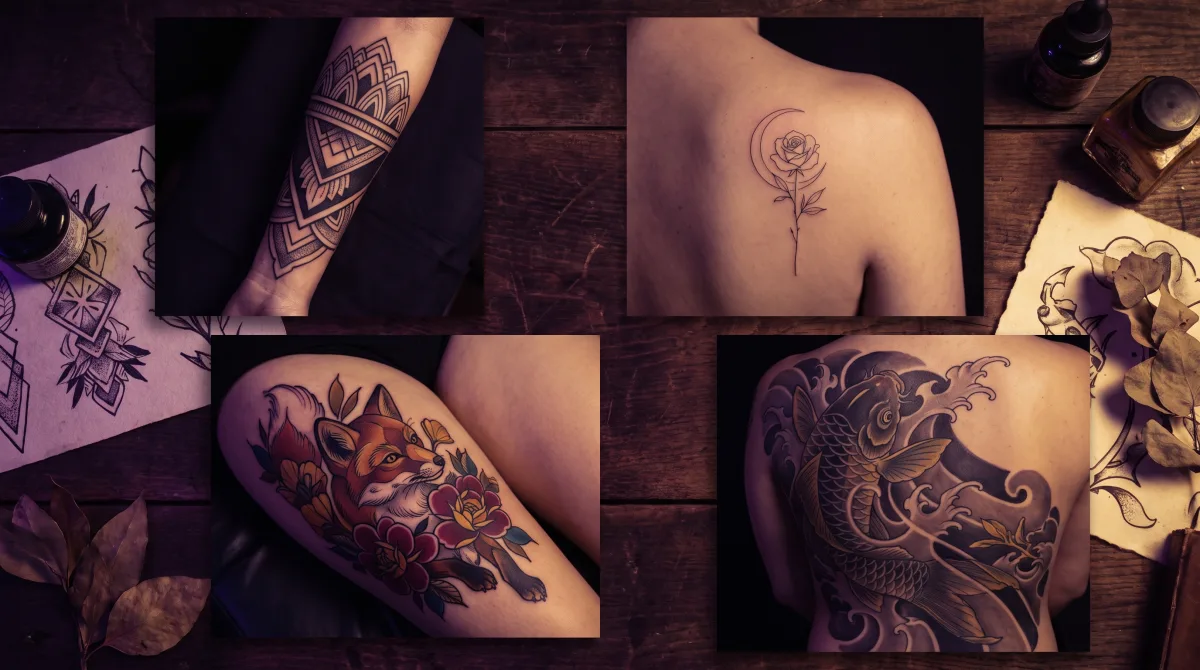
One of the most common questions we get at Púrpura Tatuajes is not "how much does it cost?" but "which style should I choose?". That makes sense: style is not just aesthetics — it also determines how your tattoo will age, how much it will hurt, how long it will take, and how easy it will be to modify later. Here is a breakdown of the main styles we work with, in plain language, so you walk into your consultation with a clear idea.
Blackwork
Works exclusively with solid black ink, no gradients or color. It can range from geometric patterns and mandalas to fully filled figures. It is one of the styles that ages best: solid black loses saturation far more slowly than color, which is also why it is the undisputed king of cover-ups.
Fine line
Ultra-thin, delicate lines, almost like pencil drawing. It is the most popular style today among people looking for something minimal: a word, a silhouette, a small symbol. Its weak spot is longevity: very thin lines blur faster over the years than bold linework, so it often needs a touch-up down the road. If you are curious, we have a full guide on fine line and micro-realism.
Neo-traditional
Evolves classic American traditional tattooing (bold outlines, saturated colors) with more illustrative compositions, dimensional shading and a wider palette. It ages very well thanks to its defined outlines, and it is an excellent choice for large, high-impact pieces.
Black & grey
The entire tattoo is worked in grayscale, with soft shading that gives volume and realism without using color. It is the classic choice for portraits, animals and highly detailed, photo-driven pieces. It demands an expert hand: a bad gradient shows far more than it would in color.
Realism and micro-realism
Aims for the tattoo to look almost like a photograph on skin — portraits, animals, textures. Micro-realism applies that same technique to small pieces, something that has been in high demand in recent years. It requires artists with a high technical level, both in black and grey and in color.
Japanese (Irezumi)
One of the styles with the deepest history: dragons, koi, waves, cherry blossoms and oni masks, in compositions that often cover large areas of the body (full sleeve, back, leg). It follows very specific composition rules — it is not just "putting a wave and a dragon together" — so it is worth working with an artist who understands the tradition behind the style.
Botanical and organic fine line
Leaves, flowers, branches and natural forms, almost always in black or with minimal touches of color. It is versatile in size: it works equally well as a small piece or a full sleeve, and its organic shapes also make it a good base for future cover-ups.
Old school / American traditional
The classic flash-sheet style: bold black outlines, a few highly saturated colors (red, green, yellow, blue), iconic designs like swallows, anchors, hearts and roses. It is one of the most time-resistant styles precisely because of its bold outlines and limited palette.
Dotwork and geometric
Builds the image out of thousands of individual dots or precise geometric patterns — mandalas, sacred geometry, optical illusions. It requires a great deal of patience and technical precision; sessions tend to run longer than the design might suggest.
How to choose the right style for you
- Think about longevity. If you want something that still looks crisp 20 years from now with minimal upkeep, blackwork and old school age better than very delicate fine line.
- Think about size. Realism and black & grey need room to show off detail; fine line works best on small to medium pieces.
- Think about meaning. If you are after something symbolic with tradition behind it, Japanese or botanical usually fit better than a purely decorative design.
- Check the artist’s portfolio. Not every tattooer masters every style equally — choose based on specialty, not just calendar availability.
You can browse our team’s work by specialty on the artists page.
Frequently asked questions
Can I mix two styles in one tattoo? Yes, it is common to combine, for example, blackwork with fine line, or neo-traditional with botanical. What matters is that the artist masters both so the mix reads as intentional, not improvised.
Which style hurts the least? Pain depends more on body placement and session length than on the style itself. Styles with more shading or fill (black & grey, realism) tend to mean longer sessions. Check our pain map for more detail.
Which style is best for a first tattoo? There is no fixed rule, but fine line, botanical and small old school pieces are popular entry points because of their size and session length. Also see our first tattoo guide.
Does every Púrpura artist work every style? No — each artist has their own specialties. We help you decide who to book with based on the style you are after.
Tell us your idea and we will tell you which style fits it best
Message us on WhatsApp with your idea, references or inspiration, and we will point you toward the style and artist on our team that fits best. You can also book your consultation from the contact page.